Sunday, February 1, 2015

Shane Ambrose Weekly Artist #2


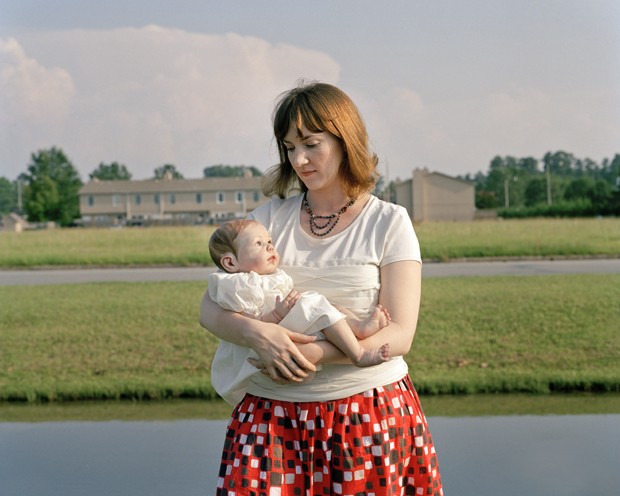
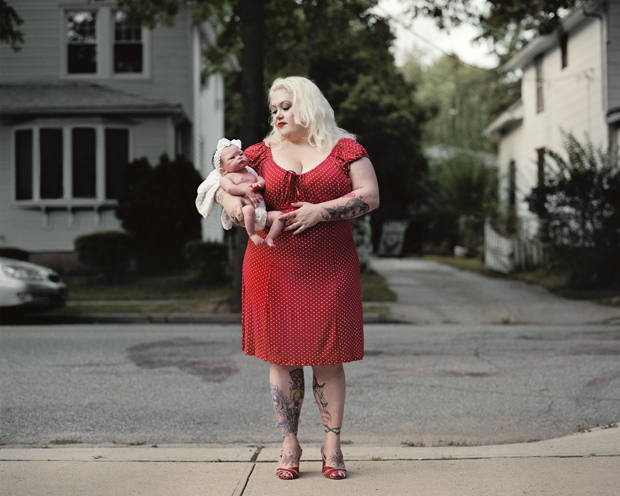
1.  In these images, Jamie Diamond works to establish striking compositions of these women and their reborn dolls with different techniques of contrast.  She not only uses the colors red and pink to offset the women from the natural colors in the background, but also adjusting the aperture of the camera to allow for a more shallow depth of field focusing the attention on the women and their inanimate infants.

2.  Diamond chooses to photograph these infants and their mothers to effectively portray the emotional power that they have over people, even though they are only lifeless artistic renditions.  Capitalizing a theme that exists as the framework of photography itself (no pun intended).

3.  I personally think that these images do an outstanding job in exhibiting the perfect blend of composition and natural emotion (of the mothers) to accurately convey a sense of warmness and congeniality with the dolls.


Cynthia Bowles- Weekly Artist 3

2
I tell my family I am HIV+. They forgot me and ate at the table.
3
If I could see your face, I would not need food.
8The best day of my life was the day I was reunited with my sister. Photograph by Mesfin Muhammed and Eric Gottesman
1. In these photos by Eric Gottesman high contrast and the black and white effect. My guess is that he used a faster shutter speed, a lower ISO and a larger aperture. Probably a 1/125th or 1/250th of a second shutter speed, 100-200 ISO, and F4-F8 aperture . He showed great detail in the people in the foreground by using a larger aperture creating a smaller depth of field. I also think that he enhanced the lights and shadows of the images as well. 
2. Gottesman paired up with Ethiopian media collectors called Sudden Flowers. He paired with them to give insight into the lives of the Ethiopian community. He wanted to show how different things are outside our own personal opinions. He wanted to show and reenact "The worst and best days of their lives" making them more joyful.
3. I really enjoyed looking at this collection. It challenged me to try to think of what settings he used because the effects are very precise. I liked how he showed the reality of Ethiopian's lives. The quotes that corresponded to the images, added more emotion making me see the expressions they had even more. I also like how the subject of the photo is not always centered so that the background also plays a role in the image. 

Breotnie Nichols - Weekly Artist Post

Elly Heise


1) I think that in this series, #DAUGHTERDOESMYMAKEUP, Elly Heise utilized a high shutter speed with a large aperture. The high shutter speed would be necessary for capturing still images of the mothers without any camera shake, if she is not using a tripod. I believe she is using a large aperture in order to achieve a shallow depth of field. Additionally, I believe that Elly Heise used a lower ISO to ensure that her images have a high quality.

2) Elly Heise goes against societal standards of beauty and instead embraces self expression. In this series she has young girls from ages 3 to 5 do their mom's makeup. The seriousness of the mothers is juxtaposed by the silly makeup that they adorn. However, it is this exact juxtaposition that strengthens Heise's idea of nonconformity and self expression. 

3) I love that Elly Heise gave these girls the platform to express themselves and that the mothers embraced this experience. I think this series shows a beautiful bond between mother and daughter. I also love the message behind it. Beauty should be about self expression, not what society deems to be beautiful. I think the way Elly Heise went about portraying this idea is absolutely wonderful.

Shane Ambrose Weekly Artist #1


1.   In these photographs by Daniel Regan, he uses a few different techniques to achieve his desired effect.  In the first one he appears to use a particularly low ISO in order to capture the textural detail of the body especially in the cuts.  In the second image, Regan appears to primarily focus on the shutter speed of his camera, using a very quick speed to capture the motion of ripping the paper from his body.  In the last image, Regan appears to use a very high ISO in order to create a very noisy image.

2.  Daniel Regan's approach to these photographs was based on the theme of mental illness that he has struggled with in his personal life.  They were taken to portray the ongoing inner struggle with one's demons in an attempt to negotiate one's identity with the clouded delusion manifested in the mind.

3.  I find these photographs, as with the rest of his images from the series, to be rather ingenious.  Having struggled with my own mental afflictions, these photos help to successfully elicit a comforting emotional response with an accurate and beautifully artistic representation of the life inside the head of a madman.

Matt Thyssen - Weekly Artist Post

Bill Ray


(1) I think that Bill Ray's technical decisions include shooting at a relatively low ISO, since most of the photos are at outdoor events in fair whether.  Probably not as much, though, when he's shooting in pool rooms and bars.  The photos I choose have a pretty deep depth of field, he tries to capture as much of the scene as possible.

(2) His conceptual ideas are to capture the Hell's Angel's lifestyle from their perspective. He kind of conveys the message that "these dudes may be outlaws, and draw attention from the law, but they're really a close knit group of brothers that just want to have fun."  He tries to show that they're not really all that bad like people tend to think.

(3) My response to these choices is very positive. I'm fully supportive of the tribal, MC lifestyle.  These guys have bonds to each other that regular friends don't have.  They live under the patch on their back, and have responsibilities to each other.  They'll always have somebody that has their back.  The photographs show that they always had fun when they were hanging out and riding with each other. I don't think there's anything wrong with that.


Weekly Artist Post #3

Christian Patterson


Christian Patterson returns to his native Fond du Lac, Wisconsin with his series, Bottom of the Lake. Patterson uses his black and white photos, to portray the quiet and desolate surroundings of Fond du Lac in the winter. It is apparent that Patterson uses a high ISO to get a better quality image for his shots. He also used a small aperture setting in the first photo for the anchor chained to the light post to be in greater depth of field than the water in the background. I would assume that Patterson used his past experience of living in Fond du Lac to capture his photographs. In all three of the photos above, he does not use people as his subjects. Instead, he displays the quiet atmosphere during the wintertime. Perhaps Patterson also used shutter speed of 1/15 and a f5.8 for aperture. Possibly because the time he took the shots, the weather was overcast and the sun was not shining as bright.

Patterson reconnects with his hometown of Fond du Lac. He does a great job at displaying his own personal history, as well as the town's history and atmosphere. It gives the sense that Patterson did in fact grow up in a small town America setting and endured the harsh brutal winters of the American north. He also does an outstanding job of displaying the geography, climate, and culture of his hometown. 

The second photograph above appealed to me the most because it creates a sense of loneliness in the tiny town. Patterson currently resides in the hustle of New York City and is constantly surrounded by many different types of people. However, in Fond du Lac, Patterson displays a sense of a constant setting in the quiet town. There are no people walking through the snowy streets. Instead, it is a snowy town where only the bar light illuminates the streets. I also liked his use of black and white for his photos because it creates a better sense of using the snow to his advantage for his photographs. We already know that the snow is covering the majority of his surroundings and he perhaps creates a sense of "black and white" and not a lot of color is in the town during the harsh winters. 

Chevon McClenney- Weekly Artist Post 3


Born in Angola in 1928 Depara first picked up a camera to record his own wedding in 1950. Years later he became the official photographer for Zairian singer Franco. While photographing Franco, Depara began photographing the Kinshasa social scene, an area located in the Democratic Republic of the Congo. Here he captured an unfiltered look into the clubs and gatherings pulsating with the Cha- Cha and Rumba rhythms that define the city in the mid-1950s to the mid-1970s. He photographed the Kinshasa social scenes but what he captured was a society that was transitioning, finding it's identity years after colonial rule. By 1975, Depara began the National Photographer for the Congolese Parliament. After Leaving behind archives of untitled negatives at his death in 1997, similar to Vivian Maier,  Depara's work has been printed and released, but with the permission of his family.

Though there was not much information on this artist, I was drawn in by the street photography, fly-on-the-wall approach to his work. It gives the viewer a glimpse of a country, a culture and a time frame which most seeing the photos weren't privy to. Many of the photos in his archives are at night as he mainly focused on the evening social scenes in Kinshasa. It's clear that some sort of flash was used to make the pictures and I enjoy that spotlight quality that illuminates the center of his photographs. I am positive that in this time frame there were difficult aspects of life as a country and people newly free from colonialism, but I like that Depara has focused on the good times that were had in the midst of all of the upheaval.

I found a familiarity with these photos, with the black frames that are around most of his photos they remind me of the infamous Instagram selfies that we are inundated with on a daily, hourly bases. I like the fact that his subjects are showing off a bit. It reminds me that although technology has changed greatly, that everyone wants to be seen, admired and "liked". All these photos need are a few hashtags..