Sunday, April 3, 2016

Bri Picone - Weekly Post 11

Robert Stivers


1)  Robert Stivers is known for his ghostly, theatrical imagery that he achieves by using darkroom techniques.  He shoots with a hasselblad medium format camera and works with gelatin silver and platinum prints. His negatives are sharp.  He throws his images out of focus in the darkroom.  Stivers is concerned with the process of creating prints and sometimes he doesn't even use negatives. 

2)  Stivers photos contain a moodiness, some are charged with emotion while others are not.  All of his images are created using a distortion of the negative, such as a blurry effect.  No two prints of his are the same.  His images are reminiscent of classical tropes such as nudes, texture, sculpture and architecture.

3)  I can see myself a bit in Stivers work.  I really enjoy how he distorts the negatives to create unique images.  I love his experimental approach and I think the resulting images are captivating and mysterious.  I love the blurriness of the first photo and the detail in the second photo.  I also really love the exaggeration of  form and motion in the third photo.

Kweku Asafu-Adjaye Weekly Post

Eliot Porter

Eliot Porter made photographs that were ahead of his time. Since he was born before the age of digital photography. He was born in 1901 in Winnetka, Illinois outside of Chicago. His father dealt with the family's real estate and helped his children learn and infuse science into their lives. This paid off on Eliot because his career is filled with what I call a photograph-scientific work. He started as a biochemical researcher at Harvard but decided to take up his hobby as a photographer full time.

This shows up in his work often because he worked a lot in nature and the outdoors. He had a passion for bird watching as a child so it only made sense that he shoots many birds in his exhibitions as well as many other environmental sites such as the Galapagos, East Africa, and Antarctica.

I love his work because this is something that I strive to do one day. He traveled to many places to capture many sights that a lot of people hear about but never get to actually visit.

Hailey Porth Weekly post


After spending some time with Eggleston's work I was reminded of Norman Rockwell's paintings. Especially his portraits. But I think it's also the colors and the texture that all the photographs have. 

I picked more of his landscapes because I am kind of on this portrait kick right now but I just need to start looking at other things like landscapes and start appropriating them so I can be taking both! I was really inspired by Eggleston's simplicity in his work. There always seems to be a theme of three main colors that are found within the picture. The lighting is most of the time seems to really set the mood of the place.  

Eggleston work looks dated however this allows me to feel nostalgic about the piece. It takes me back to memories that I had when I was a little girl. Maybe that is not so much about how he was taking the photographs but more about what he was photographing. The interior shot shows a dated scene and that reminds me so much of the color pallet they had in that time period. 

In one of the photographs you can see the "Moose Lodge" and to the left side there is a pole sticking up however, the shadow in the front of it perfectly matches up with the two which completely tried me up when I first was looking at the photograph. 

Nini Norris Weekly Post 11

Paul Matzner

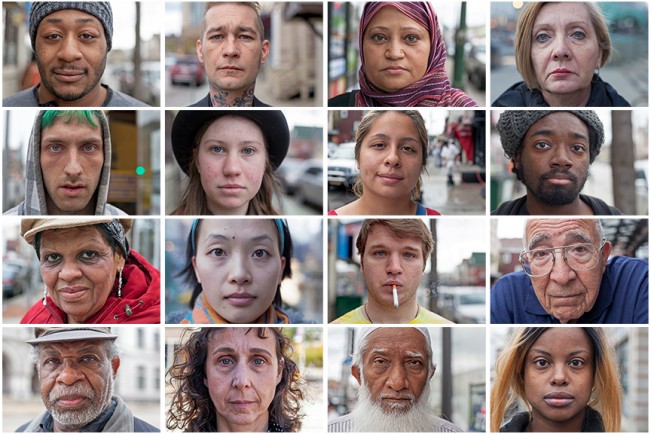
Faces contact lo-res

Paul Matzner is a Milwaukee native photographer. He switched to digital back in 2008. His series Facing You/ Facing Me, Matzner takes tight-framed portraits in color, where all of his subjects are center frame.

Matzner focuses in on the face, creating up close and personal portraits. The series is a critique of the disconnection of people in today's society.He asks his subjects to actually LOOK at him in order to share a short connection of two humans interacting. The act of looking allows for a utual appreciation and unspoken respect.

Matzner's portraits are very powerful. Eye contact is so rare and uncomfortable nowadays. These portraits force you to look at the persons face, the crinkle around their eyes, a curl of the corners of the mouth--subtle things most of us never see passing a stranger in the street or even with people we see every day.

Christina Crespo-Blog 13

Niki Boon


Boon makes only black and white photographs. The photos above are of her children. The purpose of taking these pictures was so that Boon could capture the innocence of her four children as they were growing up. 

All of these pictures seem to use natural lighting. The outer edges of the pictures are darker with the subject more lit. Boon also uses foreground and background in her images to accentuate the subject. 

I was drawn to Boons images because of the environment in which her subjects are placed. I also really like that the photos are of her children growing up on a farm. The photos remind me of a life I would want my children to have one day. 

Mollie Schaidt Weekly Post 11


Sara Cwynar


  1. Sara Cwynar is a Canadian photographer who uses both a mix of film and digital. Cwynar is inspired by the look of old film photography. She creates still-life images of "found elements", sets them up and the produces them in chromogenic prints.
  2. Cwynar makes c-prints of still life's which are manipulated in Photoshop. Photoshop takes part in every photograph she makes. Cwynar plays with the image enough so there is balance of reality and her power to deceive through manipulation. The photos that were chosen are from two different series, but the same process was used for each.
  3. My first reaction was "wow"! I love the idea of Cwynar uses old and new, and how the effect of the digital manipulation makes the photograph amazing. It seems as the photos are letting the viewer enter another realm of photography purposely deceiving the viewers eye. These images remind me of a hologram how when you move it, it changes the perspective of the picture. 


Carra Roots- Weekly Blog Post

Nue Gurel


First seeing this work, I didn’t know what to feel first. Was it the obvious fact that the heads did not belong no their body or the way I felt looking at someone now created to look like me. That to me became uncomfortable. When it comes to my own body of work, my subject can go many ways but this gave me more inspiration on body image. 

In this series, artist Nue Gurel plays with the Photoshop that magazines already do and goes in the opposite direction. She goes through this process of building up magazine pages and layers of oil paint. The task she takes on not only trying to send a message about body image but also working within an already constructed image. The layers of pain add to the colors she uses. Nue also has to keep in mind what part of the photographed body she wants to keep shown. 

From her work I will take on a message of pushing boundaries as well as another level of appropriation. I feel as though she gave us great variety, and inspired many. I want my work to do that as well.